
USB CDC Device Design in VHDL – From First Principles
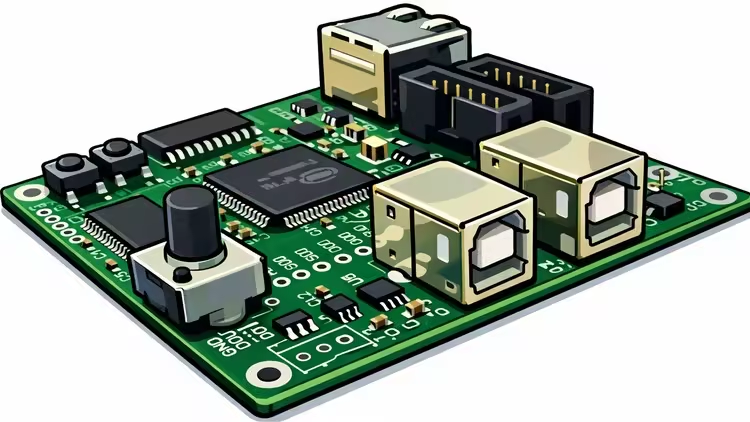
Free Download USB CDC Device Design in VHDL – From First Principles
Published 2/2026
MP4 | Video: h264, 1920x1080 | Audio: AAC, 44.1 KHz, 2 Ch
Language: English | Duration: 28h 8m | Size: 18.7 GB
Building a FIFO-Based USB CDC Interface from First Principles
What you'll learn
Understand the USB architecture from a hardware and protocol perspective
Implement a USB CDC (Communications Device Class) interface entirely in VHDL
Create and manage USB descriptors, including device, configuration, interface, and endpoint descriptors
Design control transfer handling for USB enumeration
Implement bulk IN and OUT endpoints for data communication
Build FIFO-based data paths between USB endpoints and internal FPGA logic
Design robust finite state machines for USB packet handling and flow control
Handle USB data buffering, handshaking, and error conditions
Debug USB communication using simulation and real hardware testing using Signal Tap Logic Analyser
Structure a medium-sized VHDL project for clarity, reuse, and maintainability
Requirements
Must have a basic understanding of the VHDL language
Understanding clocks, resets, and synchronous logic
Able to design simple finite state machines
If you have completed an introductory VHDL course, you are well prepared for this material.
Description
Add USB connectivity to your FPGA projectUSB is everywhere — from keyboards to mice to embedded devices and development tools to production hardware. Yet in many FPGA projects, USB is treated as a black box, hidden behind prebuilt IP cores or software libraries.In this course, you'll do something different: you'll build a working USB CDC (virtual COM port) interface entirely in VHDL, gaining a deep, practical understanding of how USB works at the hardware level — not just how to use it.Who This Course Is ForThis course is designed for engineers, students, and hobbyists who already have a basic understanding of VHDL and want to move beyond simple demonstration projects.It's ideal if you:Understand basic VHDL concepts such as signals, processes, and state machinesWant to learn how real communication interfaces are implemented in hardwareAre curious about how USB works beyond libraries and vendor IP coresWant to design FPGA systems that interact directly with a PCAre comfortable working at the register, protocol, and timing levelThis course focuses on understanding and building a USB CDC interface from first principles, not on using prebuilt blocks or high-level abstractions.Not for you if:You are completely new to VHDL or digital designYou are looking for a plug-and-play USB solutionYou only want to use vendor-provided USB IP coresYou expect minimal HDL code or a purely software-driven approachWhat You Will LearnBy the end of this course, you will be able to:Understand USB architecture at the hardware and protocol levelImplement a USB CDC interface entirely in VHDLCreate and manage USB descriptors and handle enumerationDesign bulk IN and OUT endpoints for data transferBuild FIFO-based data paths between USB endpoints and FPGA logicDebug USB communication using simulation and real hardwareWhy This Course Is DifferentMany USB tutorials rely on vendor IP cores or software stacks — this course does not.Instead, you'll:Build everything in VHDL from the ground upUnderstand what each block does and why it existsLearn to debug protocol-level issuesTake away knowledge you can reuse on other projects or platformsThe goal isn't just to make something work — it's to understand why it works.Practical OutcomesYou won't just learn theory. You will:Build a working USB CDC device in VHDL that appears as a virtual COM port on a PCExchange data between a PC and FPGA using TX and RX FIFOsDevelop a solid understanding of USB device architectureGain a reusable USB foundation adaptable to other device classes or custom protocolsPrepare for more advanced FPGA and embedded projectsSkills You'll Take AwayAfter completing this course, you'll have:A deep understanding of USB devices at the protocol levelPractical experience designing medium-sized VHDL systemsA solid foundation for advanced topics such as Ethernet, ADC/DAC interfacing, and system-level FPGA designRecommended BackgroundBefore starting this course, you should be comfortable with:Writing and simulating simple VHDL modulesDesigning simple finite state machinesUnderstanding clocks, resets, and synchronous logicUsing an FPGA toolchain to build and program a designIf you've completed an introductory VHDL course, you are well prepared for this material.Hardware Platform (FPGA Explorer Board)This course uses a modern FPGA development platform based on a Cyclone 10 LP device, featuring USB, SDRAM, user I/O, and other peripherals suitable for real-world projects.All lessons, examples, and exercises have been tested on this platform, letting you follow along step by step without needing additional hardware. Focus stays on learning VHDL and system design, not on hardware workarounds.This same platform will be used in future courses covering:Ethernet communicationADC and DAC interfacingAdvanced FPGA system designSearch eBay for "FPGA Explorer Board". See "FPGA_Explorer_Board.pdf" for more details.Search eBay for "Byte Blaster Programmer". - You will need this to program the FPGA.Ready to move beyond basic VHDL and start building real interfaces?Join the course and take the next step in your FPGA journey.
Who this course is for
Students with basic VHDL knowledge looking to move beyond simple demos
Hobbyists and makers interested in USB-enabled FPGA projects
Engineers or embedded developers who want hands-on FPGA experience
Anyone curious about USB device protocols and low-level FPGA design
Learners who want to build reusable skills for advanced FPGA projects
Homepage
https://www.udemy.com/course/usb-cdc-device-design-in-vhdl-from-first-principles/
Buy Premium From My Links To Get Resumable Support,Max Speed & Support Me
DDownload
kbnqr.USB.CDC.Device.Design.in.VHDL..From.First.Principles.part20.rar
kbnqr.USB.CDC.Device.Design.in.VHDL..From.First.Principles.part15.rar
kbnqr.USB.CDC.Device.Design.in.VHDL..From.First.Principles.part19.rar
kbnqr.USB.CDC.Device.Design.in.VHDL..From.First.Principles.part12.rar
kbnqr.USB.CDC.Device.Design.in.VHDL..From.First.Principles.part10.rar
kbnqr.USB.CDC.Device.Design.in.VHDL..From.First.Principles.part09.rar
kbnqr.USB.CDC.Device.Design.in.VHDL..From.First.Principles.part08.rar
kbnqr.USB.CDC.Device.Design.in.VHDL..From.First.Principles.part01.rar
kbnqr.USB.CDC.Device.Design.in.VHDL..From.First.Principles.part17.rar
kbnqr.USB.CDC.Device.Design.in.VHDL..From.First.Principles.part16.rar
kbnqr.USB.CDC.Device.Design.in.VHDL..From.First.Principles.part06.rar
kbnqr.USB.CDC.Device.Design.in.VHDL..From.First.Principles.part04.rar
kbnqr.USB.CDC.Device.Design.in.VHDL..From.First.Principles.part18.rar
kbnqr.USB.CDC.Device.Design.in.VHDL..From.First.Principles.part07.rar
kbnqr.USB.CDC.Device.Design.in.VHDL..From.First.Principles.part03.rar
kbnqr.USB.CDC.Device.Design.in.VHDL..From.First.Principles.part05.rar
kbnqr.USB.CDC.Device.Design.in.VHDL..From.First.Principles.part14.rar
kbnqr.USB.CDC.Device.Design.in.VHDL..From.First.Principles.part02.rar
kbnqr.USB.CDC.Device.Design.in.VHDL..From.First.Principles.part13.rar
kbnqr.USB.CDC.Device.Design.in.VHDL..From.First.Principles.part11.rar
Rapidgator
kbnqr.USB.CDC.Device.Design.in.VHDL..From.First.Principles.part15.rar.html
kbnqr.USB.CDC.Device.Design.in.VHDL..From.First.Principles.part06.rar.html
kbnqr.USB.CDC.Device.Design.in.VHDL..From.First.Principles.part13.rar.html
kbnqr.USB.CDC.Device.Design.in.VHDL..From.First.Principles.part07.rar.html
kbnqr.USB.CDC.Device.Design.in.VHDL..From.First.Principles.part12.rar.html
kbnqr.USB.CDC.Device.Design.in.VHDL..From.First.Principles.part16.rar.html
kbnqr.USB.CDC.Device.Design.in.VHDL..From.First.Principles.part08.rar.html
kbnqr.USB.CDC.Device.Design.in.VHDL..From.First.Principles.part03.rar.html
kbnqr.USB.CDC.Device.Design.in.VHDL..From.First.Principles.part10.rar.html
kbnqr.USB.CDC.Device.Design.in.VHDL..From.First.Principles.part18.rar.html
kbnqr.USB.CDC.Device.Design.in.VHDL..From.First.Principles.part02.rar.html
kbnqr.USB.CDC.Device.Design.in.VHDL..From.First.Principles.part11.rar.html
kbnqr.USB.CDC.Device.Design.in.VHDL..From.First.Principles.part17.rar.html
kbnqr.USB.CDC.Device.Design.in.VHDL..From.First.Principles.part01.rar.html
kbnqr.USB.CDC.Device.Design.in.VHDL..From.First.Principles.part20.rar.html
kbnqr.USB.CDC.Device.Design.in.VHDL..From.First.Principles.part14.rar.html
kbnqr.USB.CDC.Device.Design.in.VHDL..From.First.Principles.part19.rar.html
kbnqr.USB.CDC.Device.Design.in.VHDL..From.First.Principles.part09.rar.html
kbnqr.USB.CDC.Device.Design.in.VHDL..From.First.Principles.part05.rar.html
kbnqr.USB.CDC.Device.Design.in.VHDL..From.First.Principles.part04.rar.html
AlfaFile
kbnqr.USB.CDC.Device.Design.in.VHDL..From.First.Principles.part15.rar
kbnqr.USB.CDC.Device.Design.in.VHDL..From.First.Principles.part08.rar
kbnqr.USB.CDC.Device.Design.in.VHDL..From.First.Principles.part12.rar
kbnqr.USB.CDC.Device.Design.in.VHDL..From.First.Principles.part04.rar
kbnqr.USB.CDC.Device.Design.in.VHDL..From.First.Principles.part09.rar
kbnqr.USB.CDC.Device.Design.in.VHDL..From.First.Principles.part14.rar
kbnqr.USB.CDC.Device.Design.in.VHDL..From.First.Principles.part06.rar
kbnqr.USB.CDC.Device.Design.in.VHDL..From.First.Principles.part19.rar
kbnqr.USB.CDC.Device.Design.in.VHDL..From.First.Principles.part10.rar
kbnqr.USB.CDC.Device.Design.in.VHDL..From.First.Principles.part11.rar
kbnqr.USB.CDC.Device.Design.in.VHDL..From.First.Principles.part01.rar
kbnqr.USB.CDC.Device.Design.in.VHDL..From.First.Principles.part03.rar
kbnqr.USB.CDC.Device.Design.in.VHDL..From.First.Principles.part02.rar
kbnqr.USB.CDC.Device.Design.in.VHDL..From.First.Principles.part17.rar
kbnqr.USB.CDC.Device.Design.in.VHDL..From.First.Principles.part18.rar
kbnqr.USB.CDC.Device.Design.in.VHDL..From.First.Principles.part13.rar
kbnqr.USB.CDC.Device.Design.in.VHDL..From.First.Principles.part05.rar
kbnqr.USB.CDC.Device.Design.in.VHDL..From.First.Principles.part16.rar
kbnqr.USB.CDC.Device.Design.in.VHDL..From.First.Principles.part07.rar
kbnqr.USB.CDC.Device.Design.in.VHDL..From.First.Principles.part20.rar
FreeDL
kbnqr.USB.CDC.Device.Design.in.VHDL..From.First.Principles.part09.rar.html
kbnqr.USB.CDC.Device.Design.in.VHDL..From.First.Principles.part01.rar.html
kbnqr.USB.CDC.Device.Design.in.VHDL..From.First.Principles.part16.rar.html
kbnqr.USB.CDC.Device.Design.in.VHDL..From.First.Principles.part07.rar.html
kbnqr.USB.CDC.Device.Design.in.VHDL..From.First.Principles.part17.rar.html
kbnqr.USB.CDC.Device.Design.in.VHDL..From.First.Principles.part11.rar.html
kbnqr.USB.CDC.Device.Design.in.VHDL..From.First.Principles.part05.rar.html
kbnqr.USB.CDC.Device.Design.in.VHDL..From.First.Principles.part08.rar.html
kbnqr.USB.CDC.Device.Design.in.VHDL..From.First.Principles.part10.rar.html
kbnqr.USB.CDC.Device.Design.in.VHDL..From.First.Principles.part20.rar.html
kbnqr.USB.CDC.Device.Design.in.VHDL..From.First.Principles.part19.rar.html
kbnqr.USB.CDC.Device.Design.in.VHDL..From.First.Principles.part15.rar.html
kbnqr.USB.CDC.Device.Design.in.VHDL..From.First.Principles.part14.rar.html
kbnqr.USB.CDC.Device.Design.in.VHDL..From.First.Principles.part02.rar.html
kbnqr.USB.CDC.Device.Design.in.VHDL..From.First.Principles.part18.rar.html
kbnqr.USB.CDC.Device.Design.in.VHDL..From.First.Principles.part06.rar.html
kbnqr.USB.CDC.Device.Design.in.VHDL..From.First.Principles.part12.rar.html
kbnqr.USB.CDC.Device.Design.in.VHDL..From.First.Principles.part04.rar.html
kbnqr.USB.CDC.Device.Design.in.VHDL..From.First.Principles.part03.rar.html
kbnqr.USB.CDC.Device.Design.in.VHDL..From.First.Principles.part13.rar.html
⚠️ Dead Link ?
You may submit a re-upload request using the search feature.
All requests are reviewed in accordance with our Content Policy.
In today's era of digital learning, access to high-quality educational resources has become more accessible than ever, with a plethora of platforms offering free download video courses in various disciplines. One of the most sought-after categories among learners is the skillshar free video editing course, which provides aspiring creators with the tools and techniques needed to master the art of video production. These courses cover everything from basic editing principles to advanced techniques, empowering individuals to unleash their creativity and produce professional-quality content.
Comments (0)
Users of Guests are not allowed to comment this publication.