
| view 👀:8 |
🙍 oneddl |
redaktor: Baturi | Rating👍:
Udemy – Decoding Military Diplomacy
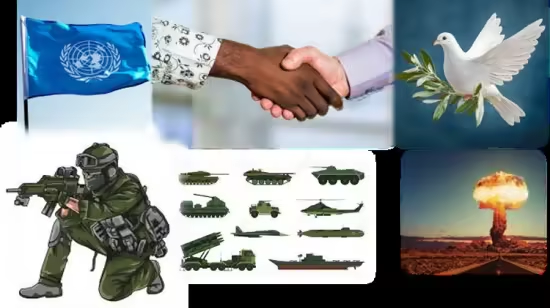
Free Download Udemy – Decoding Military Diplomacy
Published: 4/2025
MP4 | Video: h264, 1280x720 | Audio: AAC, 44.1 KHz, 2 Ch
Language: English | Duration: 1h 16m | Size: 840 MB
The Role of Hard Power in International Relations
What you'll learn
Define military diplomacy and explain its role in international relations.
Identify key actors, tools, and mechanisms involved in military diplomacy.
Analyze historical and contemporary case studies of military-diplomatic engagements.
Evaluate the ethical and legal implications of using military tools in diplomacy.
Propose actionable recommendations for resolving current global issues through effective military diplomacy.
Requirements
This course is designed to be accessible to a broad audience, with no strict prerequisites. However, to get the most value from the content, it is helpful if learners have the following: 1. A basic understanding of international relations or military strategy (not mandatory but beneficial).
2. An interest in diplomacy, conflict resolution, or security studies.
3. A background in military service, government, policy-making, or international affairs (useful but not required).
No prior military experience is necessary, as the course will introduce key concepts in an easy-to-follow manner, with historical and contemporary case studies to illustrate real-world applications.
Description
This course, Military Diplomacy: The Role of Hard Power in International Relations , provides an in-depth exploration of how military tools and strategies intersect with diplomacy to shape global politics. Military diplomacy is a critical instrument in international relations, leveraging hard power—coercion, threats, or force—to achieve diplomatic objectives while complementing soft power approaches such as persuasion, cultural influence, and economic incentives. Through theoretical frameworks, historical case studies, and contemporary examples, this course equips students with the knowledge and skills necessary to understand the complexities of military diplomacy.The curriculum begins by laying the foundational concepts of military diplomacy, including its definition, key actors (military attachés, peacekeepers, senior leaders), and theoretical underpinnings like Realism, Liberalism, and Deterrence Theory. Students will then delve into the alignment of military and diplomatic goals during peace negotiations, examining the challenges of balancing coercion with negotiation. Key mechanisms of military diplomacy, such as alliances (e.g., NATO, Warsaw Pact), peacekeeping operations, deterrence strategies, and emerging technologies like cyber warfare, are explored in detail.Additionally, the course analyzes the ethical and legal dimensions of military diplomacy through Just War Theory, international law, and human rights considerations. Historical successes and failures of peace negotiations, from the Dayton Agreement to modern conflicts in Syria and Afghanistan, provide valuable insights into the dynamics of conflict resolution. Finally, the course examines the future of military diplomacy in light of technological advancements, geopolitical shifts, and evolving security challenges.By the end of this course, participants will possess a comprehensive understanding of how military diplomacy influences global stability, fosters cooperation, and resolves conflicts in today's interconnected world.
Who this course is for
This course is ideal for: 1. Military Officers and Defense Personnel – Those seeking to understand how diplomacy and military power interact in global affairs. 2. Diplomats and Government Officials – Professionals involved in international negotiations, peacekeeping, and security cooperation. 3. Students and Scholars of International Relations – Those studying diplomacy, security studies, or conflict resolution. 4. Policy Makers and Analysts – Individuals working in think tanks, international organizations, or security policy sectors. 5. Journalists and Media Professionals – Those covering defense, foreign affairs, and security issues. 6. Business and Security Consultants – Professionals dealing with geopolitical risks and defense-related contracts.
Homepage:
https://www.udemy.com/course/decoding-military-diplomacy/
AusFile
Rapidgator
wmzll.Decoding.Military.Diplomacy.rar.html
Fikper
No Password - Links are Interchangeable
⚠️ Dead Link ?
You may submit a re-upload request using the search feature.
All requests are reviewed in accordance with our Content Policy.
Comments (0)
Users of Guests are not allowed to comment this publication.