
| view 👀:18 |
🙍 oneddl |
redaktor: Baturi | Rating👍:
Intel OneAPI 2026.0 (x64 Windows Linux)
Intel OneAPI 2026.0 | 6.4 Gb
Intel is pleased to announce the availability of Intel oneAPI Toolkit 2026.0 is a comprehensive suite of tools and libraries for developing high-performance, data-centric applications across diverse architectures.
Highlights
- With the 2026.0 release, Intel oneAPI Toolkit brings together the former Intel® oneAPI Base Toolkit and Intel oneAPI HPC Toolkit, providing the same trusted compilers, libraries, and analysis tools developers rely on today, now delivered as a single toolkit for building performance‑tuned AI, client, edge, and HPC applications.
- Intel oneAPI Toolkit continues to enable cross‑architecture CPU, GPU, and accelerator development, and in 2026.0 adds support for Clearwater Forest and Intel Core Series 3 processor while building on optimizations for Arrow Lake and Intel Core Ultra systems and strengthening Intel Arc B‑series GPU development (including Intel Arc Pro B70 Graphics) through improved code generation, runtime behavior, and profiling.
- The Intel oneAPI DPC++/C++ Compiler 2026.0 helps developers deliver higher‑performance heterogeneous C++/SYCL* applications faster by boosting execution efficiency through improved code generation (including better branch prediction) on Intel Core Ultra and Arrow Lake platforms, providing strong readiness for Clearwater Forest and Intel Core Series 3 processor, cutting iteration time with quicker AOT linking, making SYCL code more expressive and portable with enhanced free‑function kernels, device‑type queries, and expanded SYCL Graph execution using work‑group scratch memory, and making tuning and debugging more targeted with function‑scoped optimization and offload reporting, loop‑optimization controls, and more robust host‑and‑offload execution behavior.
- The Intel Fortran Compiler 2026.0 is ready to boost performance on Clearwater Forest processors and modernizes Fortran development by adopting the standard dispatch construct for cleaner, more portable offload code, improving numerical output predictability with leading‑zero editing, enabling more scalable parallel coordination with PUT with NOTIFY for coarrays, making code clearer with conditional expressions, producing higher‑quality generated code via extended prefer_type IR support, and reducing manual data‑mapping work for heterogeneous applications with automap support for allocatables on declare target enter.
- Intel oneAPI Math Kernel Library and Intel Integrated Performance Primitives expand optimized coverage and scalability for core math, signal‑processing, and data‑processing kernels in 2026.0, improving out‑of‑the‑box performance for simulation, rendering, media, and analytics workloads as CPU core counts and memory hierarchies continue to grow.
- Intel Integrated Performance Primitives in 2026.0 further enhance performance for signal processing, media, and data‑processing workloads, including enhanced Intel Cryptography Primitives Library which accelerates security‑sensitive and data‑intensive applications.
- Intel oneAPI Deep Neural Network Library and Intel oneAPI Data Analytics Library strengthen support for machine learning, deep learning, and data‑centric workloads, enabling more efficient training, inference, and preprocessing pipelines that integrate cleanly with modern AI and analytics frameworks on CPUs and GPUs.
- Intel oneAPI Threading Building Blocks and Intel oneAPI DPC++ Library enhance task‑based parallelism and standard‑based parallel algorithms, helping client, edge, and workstation applications scale efficiently across cores without manual thread management.
- As applications extend beyond a single system, the Intel MPI Library and Intel oneAPI Collective Communications Library provide scalable communication and coordination for multi‑node HPC simulations, distributed AI training, and large‑scale analytics workloads.
- Intel VTune Profiler in 2026.0 delivers deeper, more actionable insight into compute performance, memory behavior, vectorization, threading, GPU execution, and communication, enabling developers to identify and tune performance issues across client, edge, and high‑performance environments using a unified analysis approach.
Intel oneAPI DPC++/C++ Compiler
- Faster build and iteration cycles through runtime performance improvements, including quicker AOT linking, helping developers scale large applications with less compile and link overhead.
- More performance on next‑generation Intel platforms with improved branch prediction code generation for Intel Core Ultra Series 3 processor and Arrow Lake CPUs, delivering higher execution efficiency without requiring code changes.
- More expressive and portable SYCL development with enhanced free function kernel support, new device‑type query extensions, and expanded SYCL Graph capabilities using work‑group scratch memory-enabling cleaner code and more efficient execution across devices.
- Clearer insight into compiler optimizations and offload behavior with function‑scoped optimization reporting, plus new reports for reduction optimizations and ND‑range partitioning, making performance tuning more targeted and actionable.
- Greater control during performance tuning and debugging through new compiler options that allow developers to explicitly enable or disable loop optimizations when isolating issues or experimenting with transformations.
- More predictable and robust host and offload execution with added fallback controls for need_device_ptr handling and new scan support for scalars in non‑SIMD host parallel loops, improving correctness across heterogeneous workloads.
- A cleaner, more future‑ready programming model with removal of deprecated target variant dispatch and subdevice support, simplifying development and aligning with modern SYCL and offload best practices.
Intel Fortran Compiler
- A cleaner and more future‑proof parallel programming model by removing the legacy target variant dispatch construct in favor of the standard dispatch construct, simplifying offload code and improving long‑term portability and maintainability.
- More precise and standards‑compliant formatted output with support for leading‑zero editing, helping developers produce clearer, more predictable numeric output for scientific, engineering, and reporting workloads.
- Improved synchronization and coordination in parallel programs with support for PUT with NOTIFY, enabling more efficient and expressive communication patterns in distributed and coarray‑based applications.
- More expressive and readable Fortran code through support for conditional expressions, allowing developers to write clearer logic with fewer branches while maintaining performance.
- Stronger optimization and transformation opportunities inside the compiler with extended prefer_type IR support for implementation attributes, enabling better internal analysis and higher‑quality generated code for modern Fortran workloads.
- Easier and more scalable offload of dynamic data structures with support for the automap modifier on declare target enter for allocatables, reducing manual data‑mapping effort and helping developers write more maintainable heterogeneous Fortran applications.
Intel oneAPI DPC++ Library
- Delivered significant performance improvements to the radix sort algorithm, enabling faster data processing workflows.
- Introduced an experimental radix sort kernel template algorithm featuring a cutting-edge SYCL implementation of the Onesweep algorithm, available in the oneapi::dpl::experimental::kt::gpu namespace for early adopters.
Intel Distribution for GDB*
- Delivers the latest debugging capabilities and long‑term stability by rebasing to the upstream GDB 17.1 release
- Improves developer productivity and debug fidelity through expanded DWARF support, including embedded source code and new documentation for loading debug symbols for the Kobuk GFX driver, enabling more accurate, self‑contained debugging across complex toolchains and environments (DWARF Issue: DWARF and source text embedding)
- New Platform support for Clearwater Forest (CWF) and Wildcat Lake (WCL)
Intel VTune Profiler
- Added support for Wildcat Lake and Clearwater Forest processors, along with Python 3.13 and 3.14
- Improved XPU Offload analysis finalization time with the ability to select Instrumentation and Tracing Technology (ITT) top domains from both the GUI and CLI, and introduced a unified GPU / Media Hotspots analysis providing integrated performance insights across CPU, GPU, and NPU workloads
- Microsoft Visual Studio* 2019 is no longer supported; users should migrate to a supported Microsoft Visual Studio*version
Intel oneAPI Math Kernel Library
- Improved the performance of MCG59 engine for Random Number Generation on Intel® Xeon® 6 processor with P-cores.
- Improved the performance of oneMKL Pardiso in the Conditional Numerical Reproducibility mode. It benefits HPC customers that require the results to be bitwise reproducible from run to run.
- Introduced new Intel Advanced Vector Extensions 10 (Intel® AVX10) and Intel® Advanced Performance Extensions (Intel® APX) optimizations as a preview code-path. Use the environment variable MKL_ENABLE_INSTRUCTIONS=AVX10 or the related API to enable it.
Intel oneAPI Threading Building Blocks
- Delivers immediate performance gains on modern systems through internal algorithmic improvements and scheduler enhancements, including over 3x scalability gains for concurrent ordered containers on high‑core‑count platforms-allowing teams to unlock more throughput from existing hardware without changing application design.
- Simplifies optimization for complex platforms by introducing new and extended APIs that expose NUMA awareness and hybrid‑core constraints directly to the runtime, enabling oneTBB to place tasks closer to memory and on the most suitable core types for better efficiency, predictability, and scalability.
- Improves responsiveness and efficiency through new task‑level synchronization options, resource‑aware flow graph execution, and configurable runtime blocking behavior, allowing applications to reduce latency for critical work, protect shared resources, and minimize idle CPU usage on server systems.
Intel Integrated Performance Primitives Library
- Enhanced Performance: Applications using image processing and computer vision functions will see improved performance with AVX10.2 ISA support and optimized IPP functions on AVX512 hardware.
- Large Dataset Support: Signal Processing domain now supports 64-bit array sizes, enabling processing of very large datasets that exceed previous size limitations in applications.
- Expanded API Library: 130+ new Signal Processing APIs are now available, providing additional functionality and options for implementing signal processing features in projects.
Intel Cryptography Primitives Library
- Future-Proof Security: Applications gain protection against quantum computing threats with new ML-DSA and LMS post-quantum algorithms for key generation and digital signatures, ensuring long-term cryptographic security.
- Enhanced Cryptographic Standards: Support for PKCS#5 and new DRBG algorithms provides additional industry-standard cryptographic options, improving compliance and security implementation flexibility.
- Optimized Performance: SHA3 and ML-KEM algorithms deliver improved performance on Intell® Xeonl® 6 with P-cores, reducing cryptographic processing overhead and enhancing application responsiveness.
Intel oneAPI Collective Communications Library
- C API set by default and functional out-of-box support for Intel Arc Pro B60/B70 Graphics delivers optimized scale up/out performance, reducing setup time and improving computational efficiency for high-performance workloads.
- Intel Implicit SPMD Program Compiler (Intel ISPC) support for Allgather, Allreduce, Alltoall, ReduceScatter, Broadcast, and Group APIs plus enabled user-defined reduction operations accelerate distributed computing and complex multi-node processing tasks.
- Enhanced profiling tools with imbalance tracing, new memory management APIs, and SYCL graph support provide developers better visibility and control, reducing debugging time and optimizing application performance.
Intel oneAPI Data Analytics Library
- Faster adoption of scikit-learn v1.9 features with preliminary Intel Extension for Scikit-learn* support.
- Broader compatibility through expanded Array API standard alignment.
- Leaner installations with optional GPU components for CPU-optimized workflows.
Intel oneAPI Deep Neural Network Library
- Optimized support for the latest Intel processors and GPUs, delivering faster model training and inference.
- Reduced memory bottlenecks through host-side scalar memory management, optimizing critical matrix multiplication and convolution operations.
- Added support for emerging floating-point formats (MXFP8, NVFP4), enabling users to leverage state-of-the-art quantization methods that deliver faster training and inference while maintaining accuracy.
Intel MPI Library
- MPI-5.0 standard technical preview with libfabric v2.4.0 integration, extended compatibility for Intel's latest compilers while maintaining backward compatibility, and updated IMB 2021.11 with bug fixes and improved compiler compatibility - delivering faster, more reliable parallel computing.
- Extended thread-split mode support for all communication routines and significantly improved job start latency for single-node configurations, enabling faster application startup and more efficient parallel processing workflows.
- Added support for Clearwater Forest processors and technical preview of single node Intel Arc B support, providing broader hardware options and enhanced performance capabilities for high-performance computing workloads across diverse platforms.
Known Issues and Limitations
- None
Deprecations and Removals
- The Intel DPC++ Compatibility Tool has been removed in 2026.0 release. Future contributions and issue reporting are welcomed in the SYCLomatic open-source community.
- Intel oneAPI Deep Neural Network Library will no longer be part of the Intel oneAPI Toolkit starting 2027.0.
Intel oneAPI Toolkitsupports direct programming and API programming, and delivers a unified language and libraries that offer full native code support across a range of hardware including Intel and compatible processors, Intel Processor Graphics Gen9, Gen11, Gen12, Intel Iris Xe MAX graphics, Intel Data Center GPU Max Series, and Intel Arc graphics series. It also contains analysis & debug tools for development and performance tuning and tools that developers need to build, analyze, optimize, and scale HPC applications with the latest techniques in vectorization, multithreading, multi-node parallelization, and memory optimization.
Intel oneAPI toolkits - A Quick Overview
Intelis a world leader in computing innovation. The company designs and builds the essential technologies that serve as the foundation for the world's computing devices. As a leader in corporate responsibility and sustainability, Intel also manufactures the world's first commercially available "conflict-free" microprocessors.
Owner:Intel
Product Name:oneAPI Toolkit *
Version:2026.0 (Date: April 29, 2026)
Supported Architectures:x64
Website Home Page :
Languages Supported:english
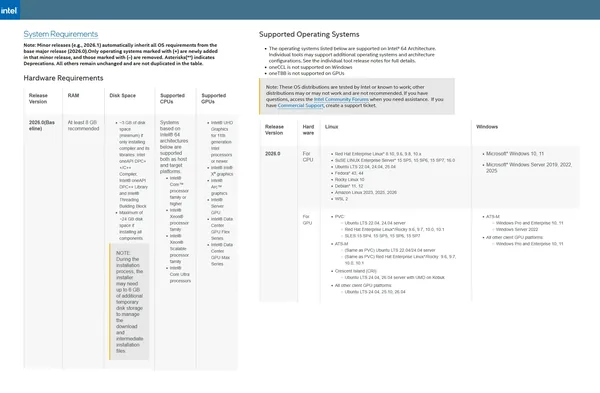
System Requirements:Windows & Linux **
Size: 6.4 Gb
* Important: With the 2026.0 Release, the Intel oneAPI Base Toolkit (Base Kit) and Intel oneAPI HPC Toolkit have been combined into the Intel oneAPI Toolkit.
![36b96f8099e759d...]()
- With the 2026.0 release, Intel oneAPI Toolkit brings together the former Intel® oneAPI Base Toolkit and Intel oneAPI HPC Toolkit, providing the same trusted compilers, libraries, and analysis tools developers rely on today, now delivered as a single toolkit for building performance‑tuned AI, client, edge, and HPC applications.
- Intel oneAPI Toolkit continues to enable cross‑architecture CPU, GPU, and accelerator development, and in 2026.0 adds support for Clearwater Forest and Intel Core Series 3 processor while building on optimizations for Arrow Lake and Intel Core Ultra systems and strengthening Intel Arc B‑series GPU development (including Intel Arc Pro B70 Graphics) through improved code generation, runtime behavior, and profiling.
- The Intel oneAPI DPC++/C++ Compiler 2026.0 helps developers deliver higher‑performance heterogeneous C++/SYCL* applications faster by boosting execution efficiency through improved code generation (including better branch prediction) on Intel Core Ultra and Arrow Lake platforms, providing strong readiness for Clearwater Forest and Intel Core Series 3 processor, cutting iteration time with quicker AOT linking, making SYCL code more expressive and portable with enhanced free‑function kernels, device‑type queries, and expanded SYCL Graph execution using work‑group scratch memory, and making tuning and debugging more targeted with function‑scoped optimization and offload reporting, loop‑optimization controls, and more robust host‑and‑offload execution behavior.
- The Intel Fortran Compiler 2026.0 is ready to boost performance on Clearwater Forest processors and modernizes Fortran development by adopting the standard dispatch construct for cleaner, more portable offload code, improving numerical output predictability with leading‑zero editing, enabling more scalable parallel coordination with PUT with NOTIFY for coarrays, making code clearer with conditional expressions, producing higher‑quality generated code via extended prefer_type IR support, and reducing manual data‑mapping work for heterogeneous applications with automap support for allocatables on declare target enter.
- Intel oneAPI Math Kernel Library and Intel Integrated Performance Primitives expand optimized coverage and scalability for core math, signal‑processing, and data‑processing kernels in 2026.0, improving out‑of‑the‑box performance for simulation, rendering, media, and analytics workloads as CPU core counts and memory hierarchies continue to grow.
- Intel Integrated Performance Primitives in 2026.0 further enhance performance for signal processing, media, and data‑processing workloads, including enhanced Intel Cryptography Primitives Library which accelerates security‑sensitive and data‑intensive applications.
- Intel oneAPI Deep Neural Network Library and Intel oneAPI Data Analytics Library strengthen support for machine learning, deep learning, and data‑centric workloads, enabling more efficient training, inference, and preprocessing pipelines that integrate cleanly with modern AI and analytics frameworks on CPUs and GPUs.
- Intel oneAPI Threading Building Blocks and Intel oneAPI DPC++ Library enhance task‑based parallelism and standard‑based parallel algorithms, helping client, edge, and workstation applications scale efficiently across cores without manual thread management.
- As applications extend beyond a single system, the Intel MPI Library and Intel oneAPI Collective Communications Library provide scalable communication and coordination for multi‑node HPC simulations, distributed AI training, and large‑scale analytics workloads.
- Intel VTune Profiler in 2026.0 delivers deeper, more actionable insight into compute performance, memory behavior, vectorization, threading, GPU execution, and communication, enabling developers to identify and tune performance issues across client, edge, and high‑performance environments using a unified analysis approach.
Intel oneAPI DPC++/C++ Compiler
- Faster build and iteration cycles through runtime performance improvements, including quicker AOT linking, helping developers scale large applications with less compile and link overhead.
- More performance on next‑generation Intel platforms with improved branch prediction code generation for Intel Core Ultra Series 3 processor and Arrow Lake CPUs, delivering higher execution efficiency without requiring code changes.
- More expressive and portable SYCL development with enhanced free function kernel support, new device‑type query extensions, and expanded SYCL Graph capabilities using work‑group scratch memory-enabling cleaner code and more efficient execution across devices.
- Clearer insight into compiler optimizations and offload behavior with function‑scoped optimization reporting, plus new reports for reduction optimizations and ND‑range partitioning, making performance tuning more targeted and actionable.
- Greater control during performance tuning and debugging through new compiler options that allow developers to explicitly enable or disable loop optimizations when isolating issues or experimenting with transformations.
- More predictable and robust host and offload execution with added fallback controls for need_device_ptr handling and new scan support for scalars in non‑SIMD host parallel loops, improving correctness across heterogeneous workloads.
- A cleaner, more future‑ready programming model with removal of deprecated target variant dispatch and subdevice support, simplifying development and aligning with modern SYCL and offload best practices.
Intel Fortran Compiler
- A cleaner and more future‑proof parallel programming model by removing the legacy target variant dispatch construct in favor of the standard dispatch construct, simplifying offload code and improving long‑term portability and maintainability.
- More precise and standards‑compliant formatted output with support for leading‑zero editing, helping developers produce clearer, more predictable numeric output for scientific, engineering, and reporting workloads.
- Improved synchronization and coordination in parallel programs with support for PUT with NOTIFY, enabling more efficient and expressive communication patterns in distributed and coarray‑based applications.
- More expressive and readable Fortran code through support for conditional expressions, allowing developers to write clearer logic with fewer branches while maintaining performance.
- Stronger optimization and transformation opportunities inside the compiler with extended prefer_type IR support for implementation attributes, enabling better internal analysis and higher‑quality generated code for modern Fortran workloads.
- Easier and more scalable offload of dynamic data structures with support for the automap modifier on declare target enter for allocatables, reducing manual data‑mapping effort and helping developers write more maintainable heterogeneous Fortran applications.
Intel oneAPI DPC++ Library
- Delivered significant performance improvements to the radix sort algorithm, enabling faster data processing workflows.
- Introduced an experimental radix sort kernel template algorithm featuring a cutting-edge SYCL implementation of the Onesweep algorithm, available in the oneapi::dpl::experimental::kt::gpu namespace for early adopters.
Intel Distribution for GDB*
- Delivers the latest debugging capabilities and long‑term stability by rebasing to the upstream GDB 17.1 release
- Improves developer productivity and debug fidelity through expanded DWARF support, including embedded source code and new documentation for loading debug symbols for the Kobuk GFX driver, enabling more accurate, self‑contained debugging across complex toolchains and environments (DWARF Issue: DWARF and source text embedding)
- New Platform support for Clearwater Forest (CWF) and Wildcat Lake (WCL)
Intel VTune Profiler
- Added support for Wildcat Lake and Clearwater Forest processors, along with Python 3.13 and 3.14
- Improved XPU Offload analysis finalization time with the ability to select Instrumentation and Tracing Technology (ITT) top domains from both the GUI and CLI, and introduced a unified GPU / Media Hotspots analysis providing integrated performance insights across CPU, GPU, and NPU workloads
- Microsoft Visual Studio* 2019 is no longer supported; users should migrate to a supported Microsoft Visual Studio*version
Intel oneAPI Math Kernel Library
- Improved the performance of MCG59 engine for Random Number Generation on Intel® Xeon® 6 processor with P-cores.
- Improved the performance of oneMKL Pardiso in the Conditional Numerical Reproducibility mode. It benefits HPC customers that require the results to be bitwise reproducible from run to run.
- Introduced new Intel Advanced Vector Extensions 10 (Intel® AVX10) and Intel® Advanced Performance Extensions (Intel® APX) optimizations as a preview code-path. Use the environment variable MKL_ENABLE_INSTRUCTIONS=AVX10 or the related API to enable it.
Intel oneAPI Threading Building Blocks
- Delivers immediate performance gains on modern systems through internal algorithmic improvements and scheduler enhancements, including over 3x scalability gains for concurrent ordered containers on high‑core‑count platforms-allowing teams to unlock more throughput from existing hardware without changing application design.
- Simplifies optimization for complex platforms by introducing new and extended APIs that expose NUMA awareness and hybrid‑core constraints directly to the runtime, enabling oneTBB to place tasks closer to memory and on the most suitable core types for better efficiency, predictability, and scalability.
- Improves responsiveness and efficiency through new task‑level synchronization options, resource‑aware flow graph execution, and configurable runtime blocking behavior, allowing applications to reduce latency for critical work, protect shared resources, and minimize idle CPU usage on server systems.
Intel Integrated Performance Primitives Library
- Enhanced Performance: Applications using image processing and computer vision functions will see improved performance with AVX10.2 ISA support and optimized IPP functions on AVX512 hardware.
- Large Dataset Support: Signal Processing domain now supports 64-bit array sizes, enabling processing of very large datasets that exceed previous size limitations in applications.
- Expanded API Library: 130+ new Signal Processing APIs are now available, providing additional functionality and options for implementing signal processing features in projects.
Intel Cryptography Primitives Library
- Future-Proof Security: Applications gain protection against quantum computing threats with new ML-DSA and LMS post-quantum algorithms for key generation and digital signatures, ensuring long-term cryptographic security.
- Enhanced Cryptographic Standards: Support for PKCS#5 and new DRBG algorithms provides additional industry-standard cryptographic options, improving compliance and security implementation flexibility.
- Optimized Performance: SHA3 and ML-KEM algorithms deliver improved performance on Intell® Xeonl® 6 with P-cores, reducing cryptographic processing overhead and enhancing application responsiveness.
Intel oneAPI Collective Communications Library
- C API set by default and functional out-of-box support for Intel Arc Pro B60/B70 Graphics delivers optimized scale up/out performance, reducing setup time and improving computational efficiency for high-performance workloads.
- Intel Implicit SPMD Program Compiler (Intel ISPC) support for Allgather, Allreduce, Alltoall, ReduceScatter, Broadcast, and Group APIs plus enabled user-defined reduction operations accelerate distributed computing and complex multi-node processing tasks.
- Enhanced profiling tools with imbalance tracing, new memory management APIs, and SYCL graph support provide developers better visibility and control, reducing debugging time and optimizing application performance.
Intel oneAPI Data Analytics Library
- Faster adoption of scikit-learn v1.9 features with preliminary Intel Extension for Scikit-learn* support.
- Broader compatibility through expanded Array API standard alignment.
- Leaner installations with optional GPU components for CPU-optimized workflows.
Intel oneAPI Deep Neural Network Library
- Optimized support for the latest Intel processors and GPUs, delivering faster model training and inference.
- Reduced memory bottlenecks through host-side scalar memory management, optimizing critical matrix multiplication and convolution operations.
- Added support for emerging floating-point formats (MXFP8, NVFP4), enabling users to leverage state-of-the-art quantization methods that deliver faster training and inference while maintaining accuracy.
Intel MPI Library
- MPI-5.0 standard technical preview with libfabric v2.4.0 integration, extended compatibility for Intel's latest compilers while maintaining backward compatibility, and updated IMB 2021.11 with bug fixes and improved compiler compatibility - delivering faster, more reliable parallel computing.
- Extended thread-split mode support for all communication routines and significantly improved job start latency for single-node configurations, enabling faster application startup and more efficient parallel processing workflows.
- Added support for Clearwater Forest processors and technical preview of single node Intel Arc B support, providing broader hardware options and enhanced performance capabilities for high-performance computing workloads across diverse platforms.
Known Issues and Limitations
- None
Deprecations and Removals
- The Intel DPC++ Compatibility Tool has been removed in 2026.0 release. Future contributions and issue reporting are welcomed in the SYCLomatic open-source community.
- Intel oneAPI Deep Neural Network Library will no longer be part of the Intel oneAPI Toolkit starting 2027.0.
Intel oneAPI Toolkitsupports direct programming and API programming, and delivers a unified language and libraries that offer full native code support across a range of hardware including Intel and compatible processors, Intel Processor Graphics Gen9, Gen11, Gen12, Intel Iris Xe MAX graphics, Intel Data Center GPU Max Series, and Intel Arc graphics series. It also contains analysis & debug tools for development and performance tuning and tools that developers need to build, analyze, optimize, and scale HPC applications with the latest techniques in vectorization, multithreading, multi-node parallelization, and memory optimization.
Intel oneAPI toolkits - A Quick Overview
Intelis a world leader in computing innovation. The company designs and builds the essential technologies that serve as the foundation for the world's computing devices. As a leader in corporate responsibility and sustainability, Intel also manufactures the world's first commercially available "conflict-free" microprocessors.
Owner:Intel
Product Name:oneAPI Toolkit *
Version:2026.0 (Date: April 29, 2026)
Supported Architectures:x64
Website Home Page :
https://software.intel.com/
Languages Supported:english
System Requirements:Windows & Linux **
Size: 6.4 Gb
* Important: With the 2026.0 Release, the Intel oneAPI Base Toolkit (Base Kit) and Intel oneAPI HPC Toolkit have been combined into the Intel oneAPI Toolkit.
Buy Premium From My Links To Get Resumable Support,Max Speed & Support Me
Rapidgator
IntelOneAPI20260.html
AlfaFile
m5qpq.Intel-OneAPI-2026-0.part1.rar
m5qpq.Intel-OneAPI-2026-0.part2.rar
DDownload
m5qpq.Intel-OneAPI-2026-0.part1.rar
m5qpq.Intel-OneAPI-2026-0.part2.rar
FreeDL
m5qpq.Intel-OneAPI-2026-0.part1.rar.html
m5qpq.Intel-OneAPI-2026-0.part2.rar.html
Links are Interchangeable - No Password - Single Extraction
⚠️ Dead Link ?
You may submit a re-upload request using the search feature.
All requests are reviewed in accordance with our Content Policy.
Discovering free software download can be a game-changer for users looking to enhance their digital experience without breaking the bank. These platforms offer a vast array of software free download options, covering everything from productivity tools to entertainment applications. The beauty of these sites is not just the price (or lack thereof) but also the variety and accessibility they provide, ensuring that there's something for every type of user.
Comments (0)
Users of Guests are not allowed to comment this publication.