
| view 👀:58 |
🙍 oneddl |
redaktor: Baturi | Rating👍:
Schrodinger Suites 2026– 2 Advanced Version with Documentation (x64)
Free Download Schrodinger Suites 2026-2 | 34.1 Gb
The software developer Schrödinger continuously strive to develop scientific solutions that push the boundaries of molecular design and are delighted to share enhanced drug discovery and materials workflows in Schrödinger's 2026-2 software release.
Schrodinger Suites 2026-2 Release Notes
Small Molecule Drug Discovery
Platform Environment
Maestro Graphical Interface
- Interactive 2D Overlay: Precision marquee and lasso selection on the 2D Overlay that synchronizes instantly to the Workspace, bypassing the visual clutter of the 3D binding site.
- Task Tool Smart Search: Intelligent, fuzzy search that understands user intent – instantly locating the desired panels even with typos or conceptual queries like 'dockng' or 'T-cell'
- Maestro Assistant:
. Agentic Status Indicators: Real-time status updates replace the generic loading animation, so you always know what the assistant is doing.
. Multiple persistent chat sessions – Users can now create, rename, switch between, and delete multiple chat sessions, each maintaining its own conversation history.
. Privacy & Transparency Controls: Users can now enable or disable the Maestro Assistant directly from Preferences, with clear in-UI communication of the current privacy mode. The updated welcome screen and persistent AI disclaimer footer reinforce that your workspace structures are never sent to the LLM.
- Surfaces: Projecting ESP and Fukui reactivity maps onto Jaguar-computed electron density isosurfaces is now a single-click action, where previously it required multiple manual steps.
Force Field
- Improvement in the accuracy of metal complexes and metal-ligand interactions of specific metal ions (Ca(II), Mg(II), Fe(II), Zn(II), Pt(II), Ir(III)) from the addition of the metals polarizable force field via OPLS5. Current application support is in relative/absolute binding FEP+ and Desmond (beta).
Target Validation & Structure Enablement
Protein Preparation
- Improved ease of use to assess clashes with crystal mates in the Diagnostics panel
- New and improved side-chain reconstruction algorithm
- Better logging of use and matching of FASTA sequences to entry
- Academic Maestro can now minimize prepared structures
- Automatically fix bonding of sulfoximines, which are often incorrectly assigned in the wwPDB/CCD
- New option to automatically add glycosylation bonds in Maestro
- Detect ring spears during preprocessing, displaying them in the 'Overlapping' Diagnostic pane
Predictive Tox Panel
- Full release of the Predictive Tox panel for screening unknown liabilities
- Open beta release of the Predictive Tox SAR panel for automated production of high accuracy atomistic models of common anti-targets using existing SAR
Binding Site & Structure Analysis
Mixed Solvent MD (MxMD)
- Save a manual step with automatic execution of SiteMap rescoring as part of MxMD simulations
- Density maps are now written in ccp4 format instead of cns
Hit Identification & Virtual Screening
Docking
- The high-accuracy MacroDock macrocycle docking workflow is now available from the command line
- Enhanced performance and efficiency in ultra-large library screening with Generative Glide (Beta): Efficiently screen ultra-large on-demand synthesizable libraries with generative AI in a fraction of the time as AL-Glide and brute force approaches
Ligand Preparation
Enumeration
- New interface to enumerate novel molecules using generative AI for molecular materials with the REINVENT method
Shape Screening
- QuickShape now stores oned_screen results as .csv
ABFEP
- Apply restraints from the interface
Lead Optimization
FEP+
- Identify the optimal simulation time to maintain accuracy with time-sliced statistics
- Share FEP+ protocols across Web Services (GraphDB), Active Learning FEP, and the FEP+ Protocol Builder for consistency with easy import and export of new FEP+ protocol configuration files
- Improved Force Field parameter merging
- Improved cycle-closure calculation performance by up to 100x by saving subcycles and graph traversal
Protein FEP
- Renamed protein "selectivity" to "affinity" to be consistent with residue scanning
FEP+ Protocol Builder
- Account for "grouped" compounds when assigning test/train splits
Macrocycles
- Macrocycle Score: New semi-automated workflow to optimize and score macrocyclic cores for a given set of conformers, with support for high-fidelity scoring with MLFFs and QM
- Macrocycle Stability: New script for using binding pose metadynamics to rank macrocyclizations for stability compared to a reference molecule
- Macrocyclize: More detailed rejection reasons are now reported for cyclization reactions
- Macrocyclize: Automated enumeration of all L- and D-amino acid attachment pairs for custom SMILES linkers in peptide mode
- Prime Macrocycle Sampling: New command-line argument, -use_random_seed, to set a random seed during sampling
- Prime Macrocycle Sampling: New command-line argument, -curvature_tol, to specify curvature restraints during sampling
- Prime Macrocycle Sampling: New command-line argument, -freeze_torsions, to specify torsions to freeze during sampling
De Novo Design
AutoDesigner – R-group Design
- Full release of R-group Design panel
- Improved AutoDesigner PDF report
AutoDesigner – Core Design
- Full release of Core Design panel
- Improved AutoDesigner PDF report
AutoDesigner – Linker Design
- Full release of Linker Design panel
- Improved AutoDesigner PDF report
Drug Formulations
- Formulation ML: Support for proteins
Crystal Structure Prediction
- Full release of Crystal Structure Prediction with support of anhydrous Z'=2 and monohydrate crystal polymorph structures: Identify stable crystal polymorphs at zero Kelvin and room temperature for a given compound through hierarchical scoring
Docs Content
- Filter tutorials based on interest
- Materials Science Panel Explorer URLs retain filter states
- New interactive GPU licensing calculator
- Collapsible sidebar menu
Education Content
- New Tutorial: Filtering and Validating Protein-Protein Docked Poses with Macromolecular Pose Filtering and MM-GBSA Residue Scanning
- New Tutorial: Introduction to Performing Metadynamics Simulations with Desmond
- New Tutorial: Screening Ultra-large Libraries with Generative Glide
- New Tutorial: Peptide Cyclization
- New Tutorial: Preparing Cyclic Peptides and Aligning them to a Reference Structure
- New Interactive Tutorials: Three interactive tutorials for AutoDesigner, a de novo design algorithm for rapidly exploring large chemical space for lead optimization
. Set up Linker Design with AutoDesigner in Maestro
. Set up Core Design with AutoDesigner in Maestro
. Set up R-Group Design with AutoDesigner in Maestro
Biologics Drug Discovery
- Non-standard amino acids script (Open Beta). A command line script to simplify and speed creation of non-standard amino acid databases for residue scanning.
- Introduced a "Fast Mode" command line option for calculating protein descriptors. The new mode speeds up computation of these descriptors by about 20% on a benchmark dataset. Especially useful for large ensembles of structures.
- Enabled light-chain template subtype selection during antibody modeling. This provides greater flexibility when selecting templates for generating antibody structural models.
- Added the lengths of antibody Complementarity-Determining Regions (CDRs) to the output of calculated protein descriptors for antibody profiling analyses.
Materials Science
GUI for Quantum ESPRESSO
Product: Quantum ESPRESSO (QE) Interface
- Reduced disk space usage for calculating partial charges
- Bader charge analysis (command line, requires Badar module installation)
- Parallelization over both bands and tasks (command line)
- Support for MLFF in NEB calculations
Defect Properties:
Product: MS DefectPro
- Defect Formation Energy Diagram: Analysis panel for defect energy
Microkinetics
Product: MS Microkinetics
- Improved UI for renaming reactions
- User control of displayed stage in the Final State tab
Active Learning Optoelectronics
Product: Active Learning Optoelectronics
- (+MATSCI_OPTO_AL_ML) Access to ML property prediction models
- Prediction for fluorescence
Reactivity
Product: MS Reactivity
- Reaction Network Viewer: Color scheme to identify reactants
- Nanoreactor: Setup for number of stored structures to calculate biasing potential (command line)
- Nanoreactor: Improved sampling of input conformations
- Nanoreactor: Option to use AutoTS for transition state analysis
Crystal Structure Prediction
Product: Crystal Structure Prediction
- Crystal Structure Prediction: Support for Z'=2 and monohydrates
Advanced Force Field Applications
Product: MS FF Applications
- Infrastructure: Support for metals with OPLS5 from the materials science workflows (open beta)
Transport Calculations via MD simulations
Product: MS Transport
- Diffusion Coefficient: Support for multi-component diffusion analysis
- Ionic Conductivity: Output report in the driver log for command-line access
- Thin Plane Shear: Support for viscosity prediction from velocity profile
Coarse-Grained (CG) Molecular Dynamics
Product: MS CG
- Coarse-Grained Mapping: Standardized color scheme for Martini protein residues
- Backmapping: (+COARSE_GRAIN_BACKMAPPING) Algorithm to map coarse-grained structures to all-atom models
- Coarse-Grained FF Assignment: Automatic setup of restraints for DPD mapping
- CG FF Builder: (+CGFF_BUILDER_PARAM_NO_RESPONSE) Improvements to fitting algorithms for bond and angle terms
- CG FF Builder: Martini type guesses made visible to users
- Particle and residue names visible in MS Maestro
- Improved Martini parameters for linear polysaccharides
Complex Bilayer Builder
Product: MS Complex Bilayer Builder
- Membrane Analysis: Automated head/tail assignment independent of pdb names
Formulation ML
Product: MS Formulation ML
- Formulation ML: Support for protein
- Formulation ML: Support for aggregation functions over ingredient descriptors
Layered Device ML
Product: MS Layered Device ML
- Support for using existing device models as descriptors for new device models
Generative AI
Product: MS Generative AI
- REINVENT: Generative AI for molecular materials using the REINVENT method
MS Maestro Builders and Tools
- Disordered System: Support for barrier potential with planar interface substrates
- Interface Builder: (+INTERFACE_BUILDER) Advanced solution for building interface models
- Materials Project: API key from materialsproject.org hidden from the panel UI
- Meta Workflows: Support for order parameter analysis
- Meta Workflows: Support for bulk macromolecule relaxation protocol
- Periodic Structure Enumeration: Option to rank by electrostatic energy
- Polymer: Speed-up for building ladder polymers
- Remove Molecules from System: Speed up of up to 100X for loading CG systems
- MD Multistage: Improvements to built-in relaxation protocol 'Semicrystalline 1'
- Solvate System: Option to prevent molecular splits across periodic boundaries
- Sugar Builder: Stand-alone model building solution for common polysaccharides
Classical Mechanics
- Droplet: Coarse-grained structures enabled
- Electrolyte Analysis: Support for 2D distribution analysis of coordinating shells
- Electrolyte Analysis: Support for cluster composition analysis
- Electrolyte Analysis: Support for residence time analysis
- Electrolyte Analysis: A tab in the viewer panel to summarize analysis results
- Electrolyte Analysis: Display of RDF and structure factor plots
- Polymer Crosslink: Support for NpγT and NpAT ensembles
- Polymer Crosslink: Support for opening multiple viewer windows
- Surface Tension: (+SURFACE_TENSION_CG) Support for coarse-grained models
- Thermophysical Properties: Option to stop after a series of failed simulations
- Thermophysical Properties: Support for varying MD timesteps by temperature
- Thermophysical Properties: Display of Calibrated Tg value from the viewer panel
- Thermophysical Properties: Support for MLFF
- Umbrella Sampling: Option to export potential of mean force to CSV output
Quantum Mechanics
- Adsorption Energy: Atomic constraints setup for molecular QM calculations
- Adsorption Energy: Improved interface for setting atomic constraints
- Optoelectronic Film Properties: Option to select the excited states of interest for ISC/RISC
- Optoelectronic Film Properties: Improved parallelization for ISC/RISC
- Optoelectronic Film Properties: Geometry optimization settings for ISC/RISC
Docs Content
- Filter tutorials based on interest
- Materials Science Panel Explorer URLs retain filter states
- New interactive GPU licensing calculator
- Collapsible sidebar menu
Education Content
- New Tutorial: Protein Characterization: Part 1
- New Tutorial: De Novo Design of Novel Compounds with REINVENT
- New Tutorial: Machine Learning for Formulation Containing Proteins
- Updated Tutorial: Droplet Contact Analysis
- Updated Tutorial: Nanoreactor
- Updated Tutorial: Liquid Electrolyte Properties: Part 2
- Updated Tutorial: Defect Formation Energy Calculation
- Updated Tutorial: Crystal Structure Prediction
- Quick Reference Sheet: Sugar Builder
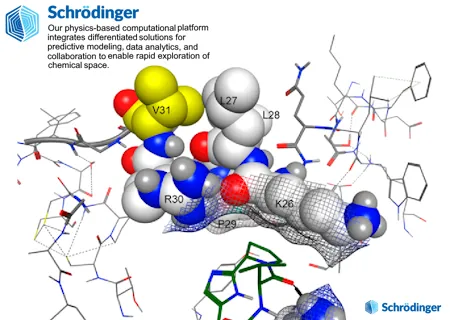
Schrödinger Software provide accurate, reliable, and high performance computational technology to solve real-world problems in life science research. It can be used to build, edit, run and analyse molecules. The Schrödinger-Suite of applications have a graphical user interface called Maestro. Using the Maestro you can prepare your structure for refinement. The following products are available: CombiClide, ConfGen, Core Hopping, Desmond, Epik, Glide, Glide, Impact, Jaguar ( high-performance ab initio package), Liaison, LigPrep, MacroModel, MCPRO+, Phase, Prime, PrimeX, QikProp, QSite, Semi-Empirical, SiteMap, and Strike.
Schrödinger Release 2026-2 | Life Science - New Features
https://www.youtube.com/embed/4VEasoWX2Lo
Schrödinger Release 2026-2 | Materials Science - New Features
https://www.youtube.com/embed/yMKz4Bkwo90
Schrödinger, LLC provides scientific software solutions and services for life sciences and materials research, as well as academic, government, and non-profit institutions around the world. It offers small-molecule drug discovery, biologics, materials science, and discovery informatics solutions; and PyMOL, a 3D molecular visualization solution. The company was founded in 1990 and is based in Portland, Oregon with operations in the United States, Europe, Japan, and India.
Owner: Schrödinger, LLC
Product Name: Schrödinger Suites
Version: 2026-2 Advanced Version with Documentation *
Supported Architectures: x64
Website Home Page :
https://www.schrodinger.com
Languages Supported: english
System Requirements: Windows, Linux, macOs **
Size: 34.1 Gb
* Notes: All workflows that rely on Desmond are not supported on Windows or Mac platforms, they can only be run on Linux.
This includes Molecular Dynamics, IFD-MD, FEP+, WaterMap, and a number of Materials Science workflows. GPU machine learning applications such as Active Learning Glide and DeepAutoQSAR on GPU can only be run on Linux.
System Requirements
Schrodinger Suites 2026-2

Buy Premium From My Links To Get Resumable Support,Max Speed & Support Me
Rapidgator
SchrodingerSuites20262.html
DDownload
arbn1.Schrodinger-Suites-2026-2-Linux.part1.rar
arbn1.Schrodinger-Suites-2026-2-Linux.part2.rar
arbn1.Schrodinger-Suites-2026-2-Linux.part3.rar
arbn1.Schrodinger-Suites-2026-2-Linux.part4.rar
arbn1.Schrodinger-Suites-2026-2-macOS.part1.rar
arbn1.Schrodinger-Suites-2026-2-macOS.part2.rar
arbn1.Schrodinger-Suites-2026-2-macOS.part3.rar
arbn1.Schrodinger-Suites-2026-2-Window.part1.rar
arbn1.Schrodinger-Suites-2026-2-Window.part2.rar
arbn1.Schrodinger-Suites-2026-2-Window.part3.rar
FreeDL
arbn1.Schrodinger-Suites-2026-2-Linux.part1.rar.html
arbn1.Schrodinger-Suites-2026-2-Linux.part2.rar.html
arbn1.Schrodinger-Suites-2026-2-Linux.part3.rar.html
arbn1.Schrodinger-Suites-2026-2-Linux.part4.rar.html
arbn1.Schrodinger-Suites-2026-2-macOS.part1.rar.html
arbn1.Schrodinger-Suites-2026-2-macOS.part2.rar.html
arbn1.Schrodinger-Suites-2026-2-macOS.part3.rar.html
arbn1.Schrodinger-Suites-2026-2-Window.part1.rar.html
arbn1.Schrodinger-Suites-2026-2-Window.part2.rar.html
arbn1.Schrodinger-Suites-2026-2-Window.part3.rar.html
Links are Interchangeable - No Password - Single Extraction
⚠️ Dead Link ?
You may submit a re-upload request using the search feature.
All requests are reviewed in accordance with our Content Policy.
Discovering free software download can be a game-changer for users looking to enhance their digital experience without breaking the bank. These platforms offer a vast array of software free download options, covering everything from productivity tools to entertainment applications. The beauty of these sites is not just the price (or lack thereof) but also the variety and accessibility they provide, ensuring that there's something for every type of user.
Comments (0)
Users of Guests are not allowed to comment this publication.