
| view 👀:5 |
🙍 oneddl |
redaktor: book24h | Rating👍:
Money in Imperial Rome Legal Diversity and Systemic Complexity (Oxford Studies on the Roman Economy) [#959871]
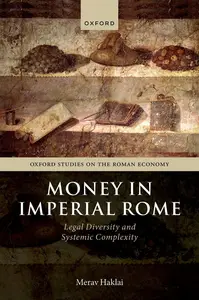
Free Download Money in Imperial Rome: Legal Diversity and Systemic Complexity (Oxford Studies on the Roman Economy) by Merav Haklai
English | September 12th, 2025 | ISBN: 0198912005 | 400 pages | True EPUB | 1.30 MB
Money in Imperial Rome offers an in-depth examination of the institutional framework within which money operated as an economic agent in the Roman empire, emphasising its systemic complexity. Analyses focus on classical Roman law as reflected in the writings of Roman jurists from the second and early-third centuries AD. The legal sources are augmented with documentary materials, which give independent evidence of actual practice, and with Jewish legal sources, which give evidence of a separate contemporary legal tradition. The work promotes Keynesian claims for the endogenous nature of money and adopts approaches advanced by new institutional economics (NIE), while its innovative contribution is in suggesting a complexity-oriented approach to understanding the conceptual framework that dictated the use of money in private transactions. Money is a complex phenomenon in the sense that it allows for new patterns of activity to be created by individuals, who adjust their use of it to the continuously evolving system in which they operate.
The book is divided into four parts. The first part is introductory. The second part traces a line of thought consistent in legal developments that regulated exchange, which perceived money as a unique phenomenon, different from all other items; therefore, specific rules were applied to money and a special role was allocated to it in defining the status of the parties. This is detectable for price (pretium) in the Roman contract for sale (emptio venditio), remuneration (merces) in the Roman contract for lease and hire (locatio conductio), and Jewish legal rules regarding sales conducted via a mode of acquisition known as 'acquisition by drawing' (qinyan meshikha). The third part examines money as a financial tool. It observes the various, innovative ways Romans used the instrument of interest. Then follows a discussion of regulations regarding interest-bearing deposits, its flexible application by individuals, and the interconnected dynamics within and between three legal traditions operating under Roman regime: Roman, Jewish, and Egyptian-Hellenistic laws. Investigation then moves to credit money in the Roman world and its capacity to increase the money supply. The fourth part offers a summary of the work and some conclusions.
Buy Premium From My Links To Get Resumable Support,Max Speed & Support Me
Uploady
ah11f.7z
Rapidgator
ah11f.7z.html
UploadCloud
ah11f.7z.html
Fikper
FreeDL
ah11f.7z.html
Links are Interchangeable - Single Extraction
⚠️ Dead Link ?
You may submit a re-upload request using the search feature.
All requests are reviewed in accordance with our Content Policy.
Significant surge in the popularity of free ebook download platforms. These virtual repositories offer an unparalleled range, covering genres that span from classic literature to contemporary non-fiction, and everything in between. Enthusiasts of reading can easily indulge in their passion by accessing free books download online services, which provide instant access to a wealth of knowledge and stories without the physical constraints of space or the financial burden of purchasing hardcover editions.
Comments (0)
Users of Guests are not allowed to comment this publication.