
| view 👀:36 |
🙍 oneddl |
redaktor: book24h | Rating👍:
Ancient Computers, Part I - Rediscovery, Edition 2 [#434454]
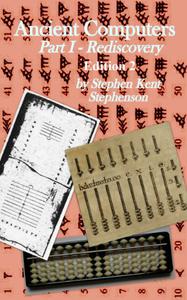
Stephen Kent Stephenson, "Ancient Computers, Part I - Rediscovery, Edition 2"
English | 2013 | ISBN: 1490964371 | ASIN: B00DVPPQ78 | EPUB | pages: 74 | 1.0 mb
Ancient Computers is an excellent introduction to the calculating methods of diverse cultures across time. A mixture of history and practical techniques for understanding and using these ancient devices brings the tools of these long-forgotten civilizations to a wide audience. Stephenson writes in an easy-to-understand and accessible manner and the use of diagrams is extensive. Want know how to use an abacus or where it came from? This is the book for you! The book is appropriate for high school audiences and above. Dag Spicer Senior Curator Computer History Museum Mountain View, CA ===== The author ... makes two points that deserve wider dissemination. The first is that he sees the central dividing line of the Salamis Tablet as allowing an additive side and a subtractive side ... and notes that this approach, 'reduces the number of pebbles needed tremendously'. It also makes many calculations easier. One cannot argue with his claims of increased efficiency and this point deserves further investigation. The author's second substantive point is that in attempting to understand ancient mathematics, historians need to pay more attention to the available tools, technology, notation, and terminology to see how particular algorithms may have been performed. The author has a video of himself computing the square root of 2 using a set of Salamis Tablets following Heron's method. It takes him 25 minutes [to achieve the four sexagesimal digit precision of Yale tablet YBC 7289]. His argument is that [making and] using only [mathematical reference] tables and writing intermediate [cuneiform] results on clay would take a lot longer. From review by Prof. Duncan Melville,https://www.stlawu.edu/user/348, in Aestimatio,https://www.ircps.org/aestimatio/9/294-297. ===== People, especially historians, have long struggled to appreciate and understand how Ancient Romans, Greeks, Egyptians, and Babylonians, et al, were able to do their arithmetic calculations. Many say the Ancients "probably" used line abacuses or abaci, a.k.a. counting boards. But most then trivialize the possible impact that use would have on the Ancient cultures because they really don't think those abaci would be very powerful and that they would be extremely hard to use. The (re-)discovery this book documents and explores materialized from the author's experiences in engineering, with a knowledge that design compromises often have to be made; computer programming, especially the different number bases used; the hobby use of a Japanese abacus called the Soroban; and study of the Ancients' numbers and culture. The bottom line is that the Ancients had a powerful and lightning fast computer; powerful and fast compared to any other calculation method available to them in their time. Features included: - multi-base number modes: e.g., sexagesimal, decimal, duodecimal, or nonary; - operating on those numbers in two parts: a signed fraction of the base and a signed exponent of the base, equivalent to scientific notation; - easy and low-cost expandability; and - built-in error checking! On the "standard" Ancient line abacus doing base-10 calculations, the fraction could have 10 significant digits and the exponent 4. Certainly enough for most modern engineering or scientific problems. If you need more, though, just scribe a few more lines on the abacus and add a few more pebbles to your pouch! By the way, 170 small pebbles will suffice for any problem on the "standard" line abacus. They fit in a pouch that can be easily and comfortably carried in a man's trouser pocket. I hope you find Ancient Computers interesting and useful, -Steve Stephenson, July 15, 2010 ===== Edition 2 adds two appendices: N: Nonary Abacus as Candidate for Modern Electronic Implementation; and V: Visualizing the Basis of Abacus Arithmetic (Using Colored Chip Models). -Steve Stephenson, July 2013

Download from NovaFile
https://nfile.cc/djeJwNdQ/yg18h.A.C.P.I..R.E.2.rar
![rapidgator]()
https://rapidgator.net/file/b2a0d39a8067a95ea5d0c5978633ff69/yg18h.A.C.P.I..R.E.2.rar.html
https://nfile.cc/djeJwNdQ/yg18h.A.C.P.I..R.E.2.rar

https://rapidgator.net/file/b2a0d39a8067a95ea5d0c5978633ff69/yg18h.A.C.P.I..R.E.2.rar.html
Links are Interchangeable - No Password - Single Extraction
⚠️ Dead Link ?
You may submit a re-upload request using the search feature.
All requests are reviewed in accordance with our Content Policy.
Significant surge in the popularity of free ebook download platforms. These virtual repositories offer an unparalleled range, covering genres that span from classic literature to contemporary non-fiction, and everything in between. Enthusiasts of reading can easily indulge in their passion by accessing free books download online services, which provide instant access to a wealth of knowledge and stories without the physical constraints of space or the financial burden of purchasing hardcover editions.
Comments (0)
Users of Guests are not allowed to comment this publication.